
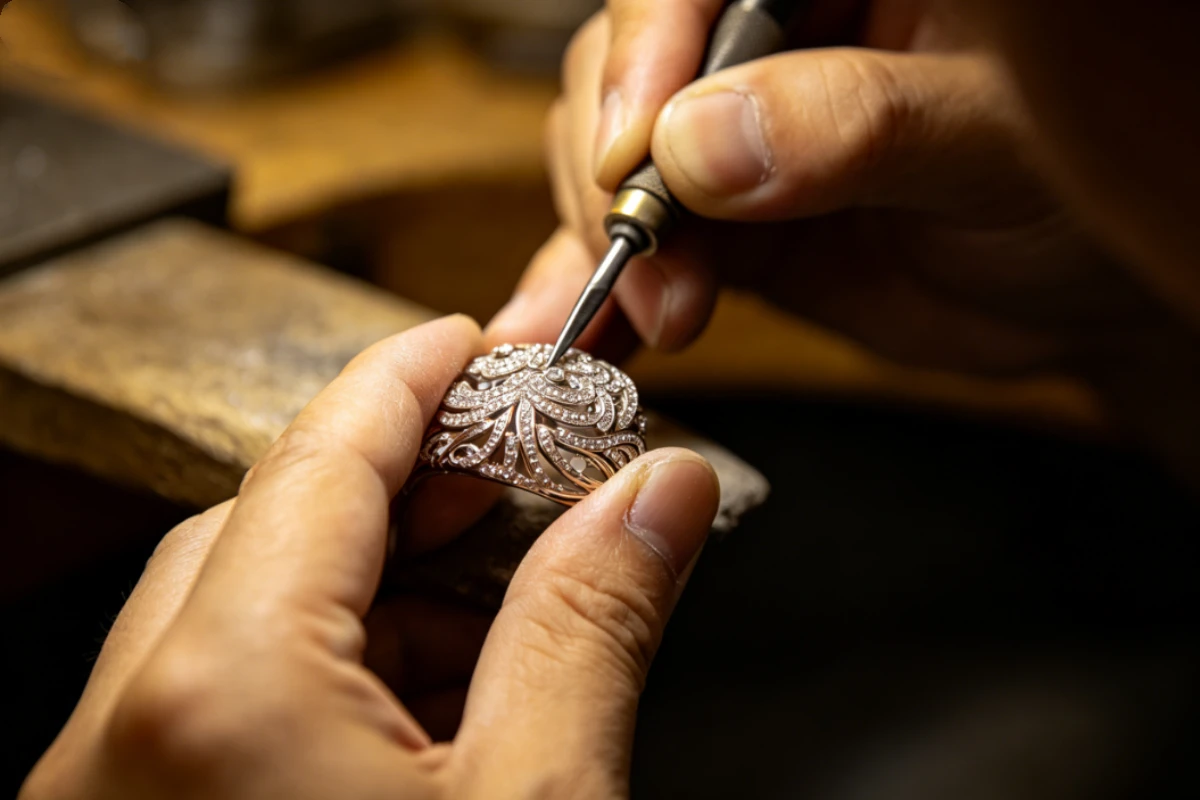
While modern engraving technology has greatly increased the speed and efficiency of jewelry production, it has also diminished the ability to capture the intricate details of traditional handcrafted work. As a result, jewelry that retains a strong handcrafted feel has become increasingly rare. Having worked in jewelry engraving for many years, I’ve clearly noticed that many buyers prefer pieces with more personality and a human touch.
However, changes in engraving technology aren’t the only reason for the rising prices. So, what other factors are driving up the cost of meticulously handcrafted engravings? And how can you tell if a piece of jewelry is truly handmade?
Friends, let’s take a closer look together.
How Industrialization Has Transformed Jewelry Engraving
There are many types of modern engraving machines; as far as I know, the main ones are laser engravers, CNC engravers, and 3D printers. They all share a common feature: engraving patterns are designed on a computer, and the corresponding code is then transmitted to the machine’s control terminal to execute the instructions. The differences lie in the engraving methods and the final results. Laser engravers primarily create flat designs by using a laser to etch marks onto the surface of the material, such as on metal nameplates. CNC engravers, on the other hand, can produce layered, three-dimensional engravings on flat surfaces, such as patterns on wooden panels. 3D printers, meanwhile, build three-dimensional sculptures by layering special materials.
Since these methods rely on machines, the engraving process requires no human intervention. This saves time and effort, but the mass-produced items created on an assembly line are virtually identical. However, many jewelry manufacturers have opted for machine production, resulting in people being able to buy simple, carved items at low prices, but not truly handcrafted pieces.
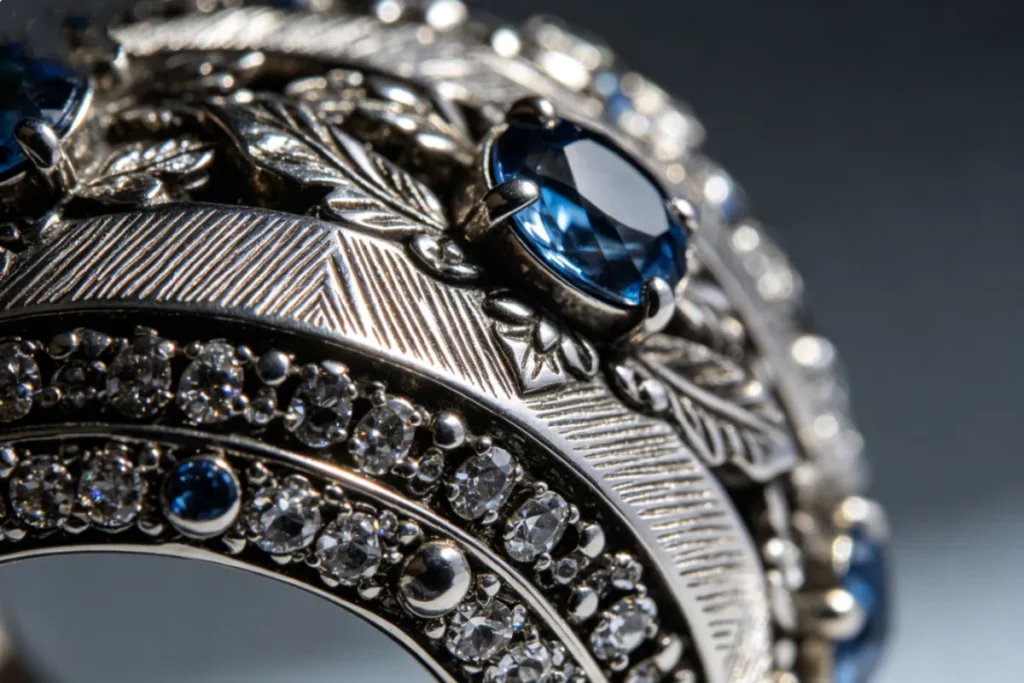
Why the “Handcrafted Touch” Has Become Rare
Under this model of carving production, machines have replaced human labor, leading to a decline in the number of hand-carving artisans. In this context, training new hand-carving artisans requires a long learning curve and entails high time costs. As a result, carving has gradually become industrialized and standardized. While some veteran artists who remain true to their craft continue to insist on purely hand-carved pieces, the quality of their output falls far short of that produced by machines, leading to a gradual scarcity of works with a genuine handcrafted touch.
Shifts in Consumer Psychology
While people are happy to purchase a decent machine-made craft at a low price, once such a product becomes a bestseller, they soon discover that whenever they visit the homes of like-minded friends, everyone has the exact same item on display. The novelty wears off, and everything begins to feel monotonous and uniform. It is precisely because most people have grown tired of a monotonous, uniform lifestyle that an increasing number are seeking the authentic feel of handcrafted art—desiring one-of-a-kind, hand-carved pieces. Just as each person is unique, they seek a sense of authenticity in objects to soothe their souls. Today’s American youth, in particular, are enthusiastic about visiting DIY carving workshops to create their own pieces. It’s not because they’re particularly skilled at carving, but because they want to own something that’s truly their own. Driven by this emotional trend, DIY jewelry carving has become increasingly popular. Sometimes, the sentimental value far outweighs the practical function. Consumers also don’t need to worry about failing to complete a carving project; on social media platforms like Etsy and TikTok, many experts share their carving experiences and simple step-by-step guides, significantly lowering the barrier to entry for beginners.
How to Spot Fake “Handcrafted” Engravings
While the number of people who love handmade items is growing, genuine handcrafted engravings are often either expensive or in short supply. Many unscrupulous sellers have begun passing off machine-engraved pieces as “100% hand-carved” to deceive consumers. It’s always disheartening to see customers fall for these fakes. That’s why I’m sharing my experience to help you quickly distinguish between authentic and counterfeit handcrafted pieces.
- Authentic carving marks: When shaping the piece, a carver uses a file to create the basic form, then polishes the edges with an air-powered engraving machine or other hand tools. The result is smooth, but upon close inspection, you’ll notice many tiny irregularities. Machine carving, however, is extremely fast, and the polishing process leaves edges perfectly smooth with no visible flaws.
- Attention to detail: Hand-carved pieces emphasize detail, such as rendering fine patterns naturally and fluidly; machine-carved details appear rigid and cannot be flexibly adjusted. When handling complex patterns, the transitions often look unnatural, and traces of “machine stuttering” may appear.
- Texture of the finished product: Hand-carved pieces have a warm, layered texture overall, with subtle variations in line details that are visually pleasing; machine-carved pieces have neat lines but lack vitality and the warmth of handwork. Upon closer inspection, they appear overly uniform and somewhat unnatural.
Beyond these points, the most important factors to consider are price and delivery time. This is especially true for custom handcrafted pieces, which cannot be delivered to you in a very short timeframe.
Balancing Machine Engraving and Hand Engraving
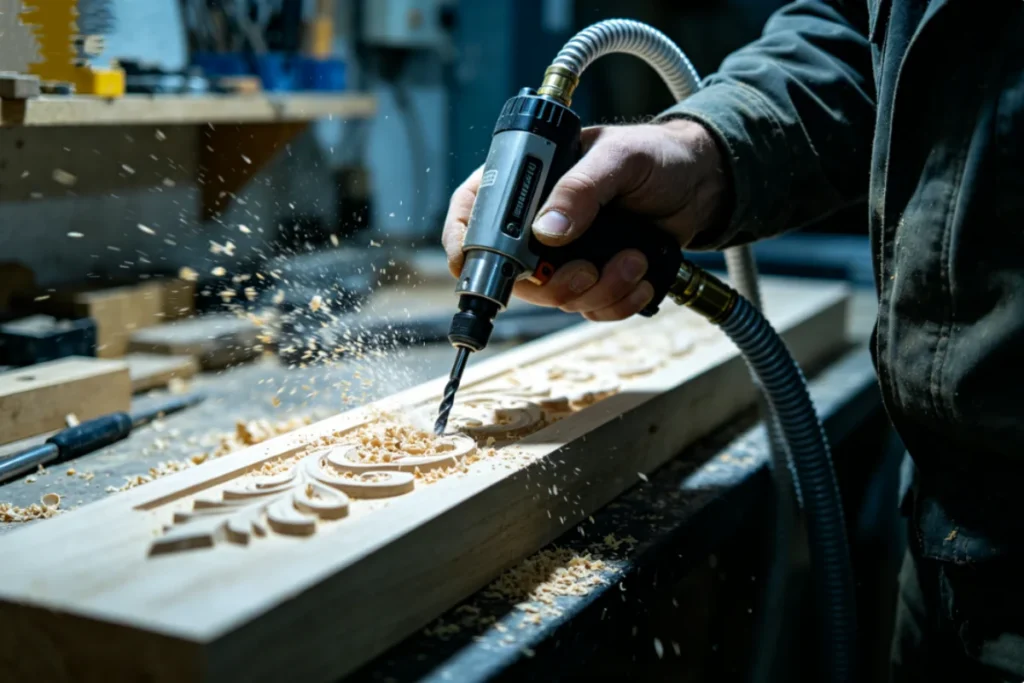
Many people believe that engraving falls into two categories: machine engraving or purely hand engraving. However, the reality is more complex. In modern jewelry workshops, pneumatic engraving tools have become an important bridge between traditional hand engraving and fully automated systems.
To describe a pneumatic engraving machine in my own words, it is essentially a high-powered automatic engraving pen. When working on hard gemstones, using engraving files can lead to rapid wear and tear due to repeated filing and engraving, often requiring multiple files for a single piece. In contrast, pneumatic engraving tools can cut gemstones directly at high speeds, yet the engraving lines and depth are controlled entirely by the operator. It can be described as an enhanced version of a “hand-carving tool,” offering engravers greater control, stability, and efficiency.
Artisans still follow pre-designed patterns and manually guide the tool along predetermined lines. This means the final product retains the natural traces of hand carving, yet offers greater consistency and reduces physical exertion. For beginners, these tools also lower the learning curve, making it easier to achieve professional-level carving results without losing the essence of traditional craftsmanship.
Staying True to Your Own Style of Carving
It is the technique of hand carving that truly embodies authenticity, which is why many people are still willing to pay a premium for works with a “handmade feel,” even as they become increasingly expensive. It is difficult for carving enthusiasts to persist in the learning process of hand carving, but owning a pneumatic engraving machine might make it much easier. Of course, no matter which method you ultimately choose to pursue your carving aspirations and style, staying true to your own heart is always the right choice.
Hi, Neat post. There’s an issue together with your site in web explorer,
may check this? IE still is the marketplace chief and a big component of other people will omit your great writing because of this problem.