

Specifications
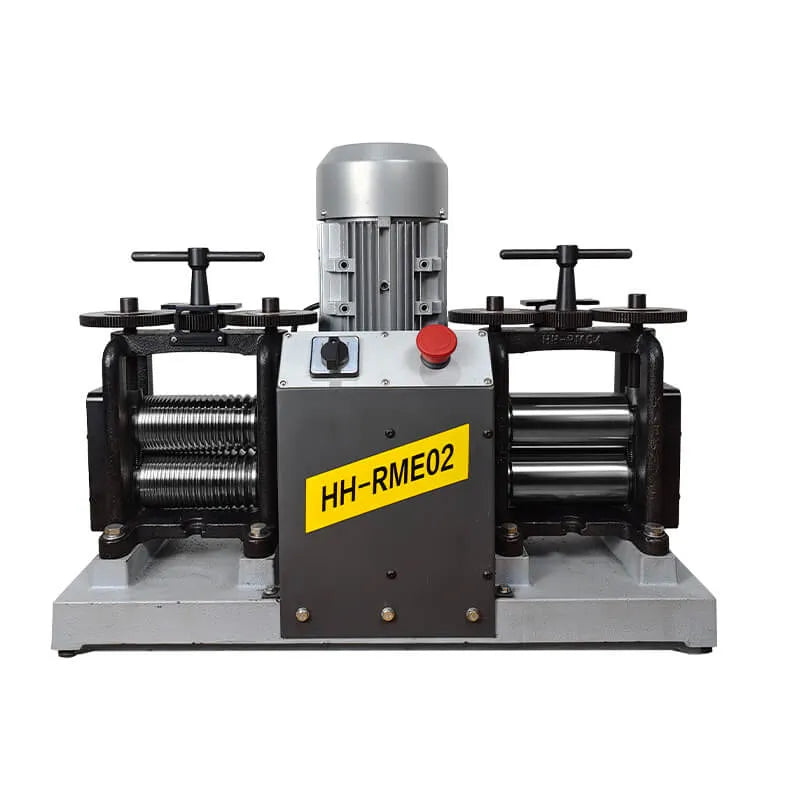
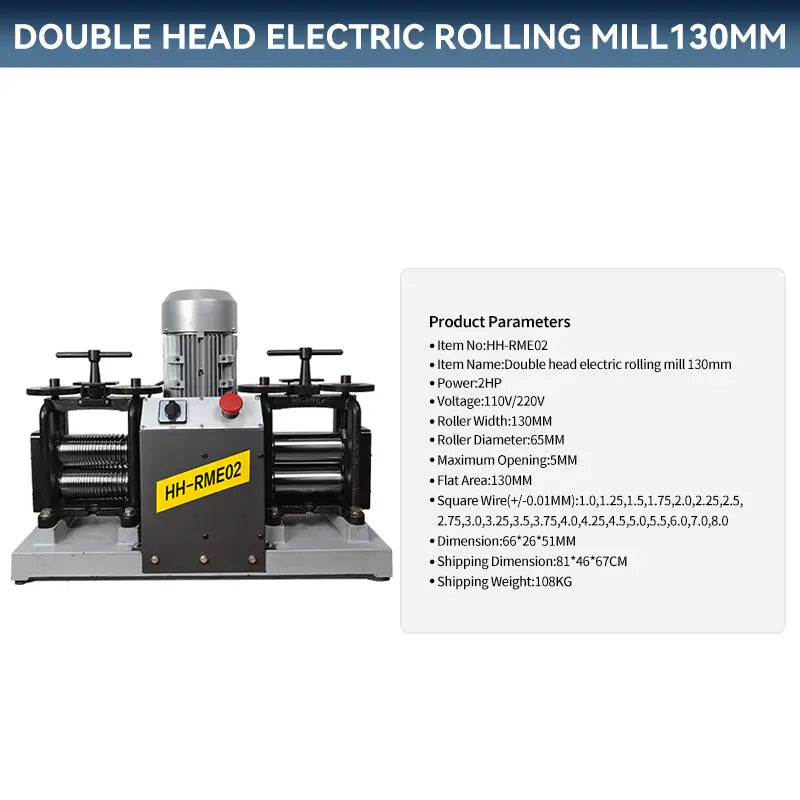
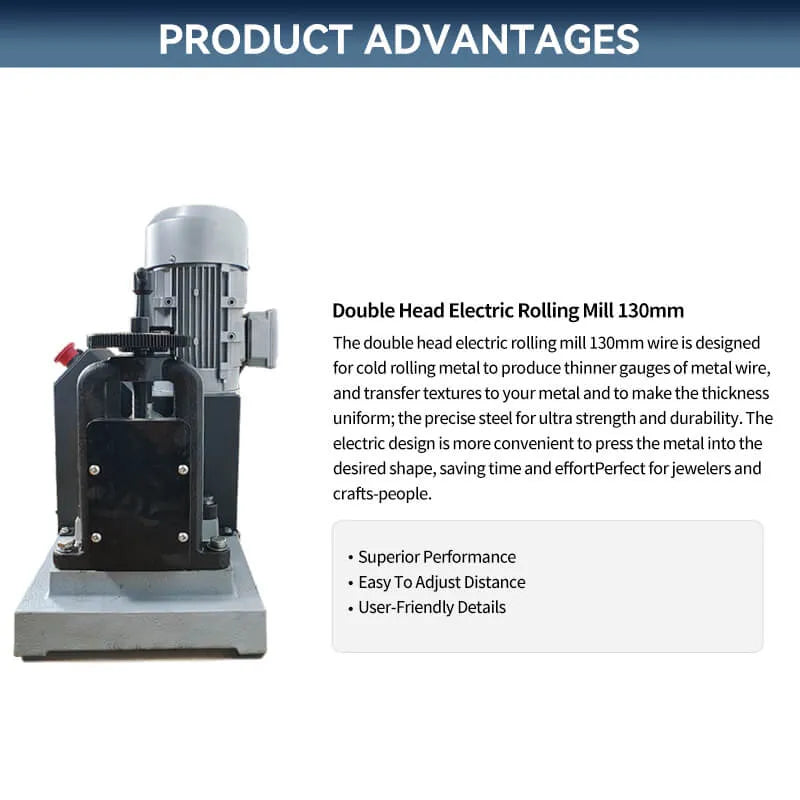
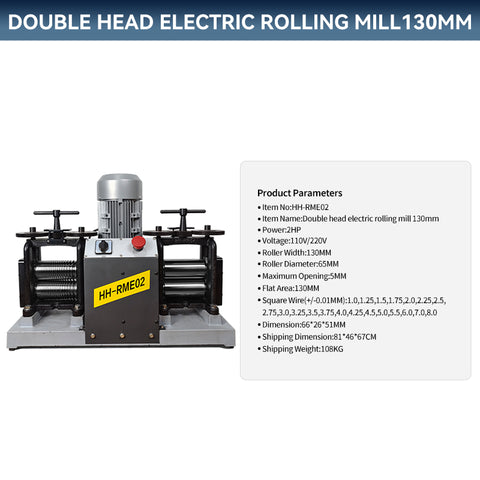
ltem No: HH-RME02
Item Name: Rolling Mill 130mm
Power: 2HP
Voltage: 110V/220V
Roller Width: 130MM
Roller Diameter: 65MM
Maximum Opening: 5MM
Flat Area: 130MM
Square Wire(+/-0.01MM): 1.0, 1.25, 1.5, 1.75, 2.0, 2.25, 2.5, 2.75, 3.0, 3.25, 3.5, 3.75, 4.0, 4.25, 4.5, 5.0, 5.5, 6.0, 7.0, 8.0
Dimension: 66*26*51MM
Shipping Dimension: 81*46*67CM
Shipping Weight: 108KG
Because this product is too heavy, it can only be transported by sea. Time to arrive in 20-25 days.
Wide Rollers (130mm) for Rolling Mills – Versatile Metalwork Applications
A rolling mill is a crucial piece of equipment in the metalworking and manufacturing industry. Its fundamental principle involves passing a metal billet through a series of pressure and shape-changing processes to reduce its cross-sectional area while increasing its length. This process is known as rolling and is accomplished through the use of a rolling mill.

Rolling mills are used to process various types of metals, including steel, copper, aluminum, alloys, and more. They find widespread applications in industries such as steel production, metal sheet manufacturing, pipe and tube production, rod and bar production, and more. Here are some key features and application areas of rolling mills:
- Shape Control: Rolling mills allow the production of metal billets in various shapes, including flat sheets, square sections, round bars, angle iron, and more, catering to the needs of different industries and projects.
2.Material Processing: Rolling mills can alter the physical properties of metals such as hardness, strength, and surface quality, making them ideal for manufacturing structural components and parts.


3.Thin Sheet Production: In industries like automotive, aerospace, and construction, rolling mills are used to produce thin sheet metals, which are used for making vehicle body parts, aircraft shells, and construction materials.

4.Rod and Wire Production: Rolling mills are employed to produce a wide range of specifications for rods and wires, used in construction, machinery manufacturing, and other applications.
5.Surface Treatment: Rolling mills can improve the quality of metal surfaces, reduce defects, and achieve high levels of gloss, making them suitable for decorative metal products.
6.Metallurgical Research: Rolling mills are also used in research settings to study the deformation behavior and performance of metals.